The importance of pronunciation in language learning.
The importance of pronunciation while learning another language.
We all know it: learning another language is amazingly interesting but it can be incredibly challenging. Between the new words, the new verbs, the new sentences structures… when one starts it can feel overwhelming.
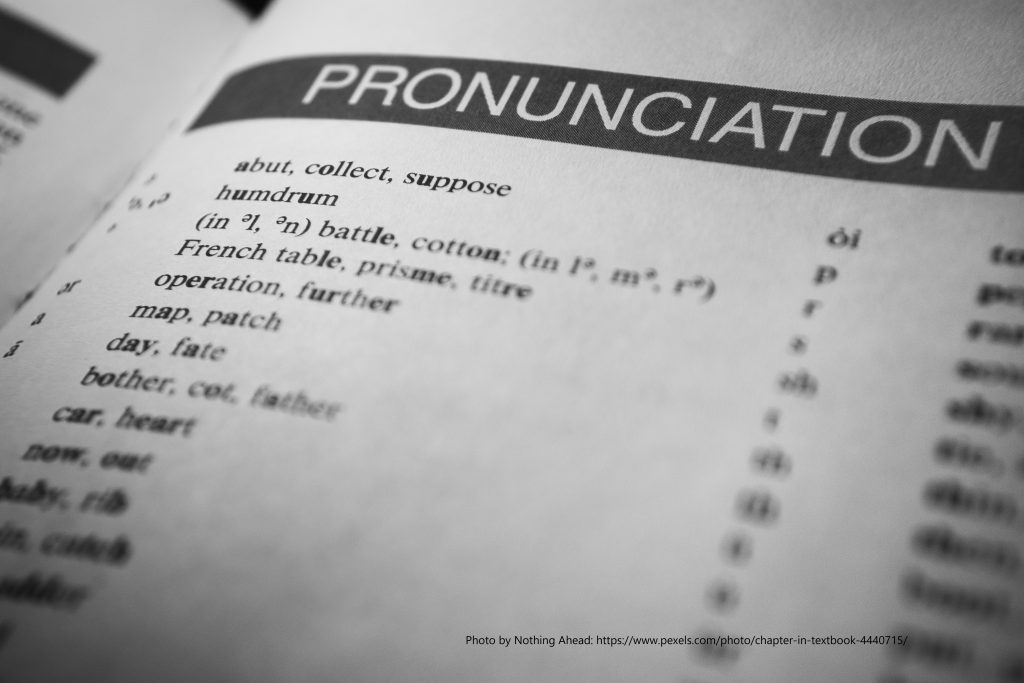
Thankfully, with a good teacher and good practice of the four skills, listening, speaking, writing and reading, it soon feels a bit more manageable and we can soon see improvements in our linguistics abilities.
There is something which can be very tricky whilst learning a new language but which is also very important, it is the pronunciation.
I have been once the learner in a language class and in everyday life when I moved to the UK 19 years ago, I know how frustrating it can be. It is not that one is not predisposed to pronouncing certain sounds, it is simply that, at times, one cannot hear such sounds.
We can for example talk about the “h” which can be tricky in French when learning English. This letter being silent at the start of the words in French, it is far from being easy or natural to hear and to pronounce for a French speaker. The English might on the other hand struggle with the letter “u” and pronounce it “ou” at the start. While those type of mistakes do not seem to be very important they can have many implications for the learners but also for the people on the receiving end.
One of the effects of mispronunciation might be misunderstanding, and, at time, saying words we did not mean to say. One French speaker wanting to say “happiness” and not pronouncing the “h” for example or an English speaker wanting to be polite while saying “merci beaucoup” but pronouncing in confusion “u” instead of a “ou” are situations which might cause a bit of embarrassment to both our learners…
Another consequence of mispronunciation is a lack of confidence in the learner. Those of us who have been trying to interact with native speakers during our learning have all been there. At times, we are certain to have said something perfectly, to only realise while looking at the baffled face of the other person that they obviously did not understand a word we said. While some might persevere and not let these hiccups stop their learning, others might on the other hand give up all together, for fear of being ridiculed or because they believe they will never improve.
This is why both listening and speaking practice are so important. While the first allows one’s ear to get accustomed to the new language’s, sounds and music, the second will allow them to practice such sounds and perfect their pronunciation.
So what are the strategies which I use in my classes of adult learners to help with pronunciation?
1. READING
Often, I ask my students to read out loud, a part of a text we are studying. This activity helps the student to gain confidence in using the language, in front of others and also to focus on certain mistakes. At the end of the reading, I will come back on certain pronunciation faux-pas and, if needed, remind everyone of certain rules (about silent letters for example).
2. PODCASTS / RECORDINGS /VIDEOS
Watching and listening to certain things can help learners to get used to sounds and the language’s melody. They can also be used to focus on a particular sound.
3. TONGUE TWISTERS
Learners generally love virelangues. They are amazing for practicing articulation, differentiation of sounds and, let’s be honest to engage learners in a very fun way! Between simply practicing in pairs or doing full on competitions, tongue twisters can really help even the shyest of learners practice and engage.
Of course, there are many ways of practicing pronunciation but the best are, in my personal opinion, taking place while interacting with others. And what better than a language class to do just that! What are your strategies to practice pronunciation or make your students practice theirs?
